




History
History of Scouting
The name "Scouting" seems to have been inspired by the important and romantic role played by military scouts performing reconnaissance in the times of wars. In fact, This idea to Robert Baden-Powell was derived from his senior officer Captain Sessile during his young age while posted in British ruled India as captain in Scout unit of English Military. Robert has assigned to dig out the source of Heavy Armed force and inestimable Hindustani warriors during First Independent Movement 1857 sway. Both of them used to visit in Indian social sector and therefore came to learn about the life style and discovered that Gurukul system of education pattern and learned that students do acquire academic and non-academic ken simultaneous during the learning tenure.
Scouting History in the World
Robert began coined the word Scouting under influenced from Indian Culture and Indian ancient system of education. The syllabus and teaching topics covered in this, actually were very much inherited in the culture of Indian Civilisation. Even the saying goes that Beden Powel got this idea by understanding teaching pattern adopted by Hindu Gurukul. He was also inspired by childhood teaching activities of Lord Shri Ram Chandra and Shri Laxman as depicted in Ramayana and added a Jungle Visit in syllabus. With the life of Balak Shri Krishana he remained astonished to know that the audacious in adolescent age.
He framed a curricular course inspired from the Grukuls teaching which includes Non-academic training. In this training module cultural, social, patriotic and calamity survival skills were combined. Kids were taught and promoted for daring task like swimming, climbing, wrestling, archery, promenade, clay modeling, weaving, smithy etc. 20 European and British students group taken for the first Scouting encampment on Brownsea Island in England. Robert wrote the principles of Scouting in Scouting for Boys (London, 1908), based on his earlier military books, with influence and support of Frederick Russell Burnham (Chief of Scouts in British Africa), Ernest Thompson Seton of the Woodcraft Indians, William Alexander Smith of the Boys' Brigade, and his publisher Pearson. The Scout method developed as a program of informal education with an emphasis on practical outdoor activities, including camping, cultural, woodcraft, aquatics, hiking, backpacking, and sports. Another widely recognized movement characteristic is the Scout uniform, by intent hiding all differences of social standing in a country and making for equality, with neckerchief and campaign hat or comparable headwear. Distinctive uniform insignia include the fleur-de-lis and the trefoil, as well as badges and other patches.
Origin
Scouting is stated as aim of supporting young people in their physical, mental and spiritual development, that they may play constructive roles in society. During the first half of the 20th century, the movement grew to encompass three major age groups each for boys (Cub Scout, Boy Scout, Rover Scout) and, in 1910, a new organization, Girl Guides, was created for girls (Brownie Guide, Girl Guide and Girl Scout, Ranger Guide). As a military officer, Robert Baden-Powell was stationed in British India and Africa in the 1880s and 1890s. Since his youth, in military scouting and as part of their training—he showed his men how to survive in the wilderness. He noticed that it helped the soldiers to develop independence rather than just blindly follow officers' orders. In 1896, Baden-Powell was assigned to the Matabeleland region in Southern Rhodesia (now Zimbabwe) as Chief of Staff to Gen. Frederick Carrington during the Second Matabele War, and it was here that he first met and began a lifelong friendship with Frederick Russell Burnham, the American born Chief of Scouts for the British. During their joint scouting patrols into the Matobo Hills, Burnham began teaching Baden-Powell woodcraft, inspiring him and giving him the plan for both the program and the code of honour of Scouting for Boys. Practiced by frontiersmen of the American Old West and Indigenous peoples of the Americas, woodcraft was generally unknown to the British, but well known to the American scout Burnham. These skills eventually formed the basis of what is now called scout craft, the fundamentals of Scouting.
Both men recognized that wars in Africa were changing markedly and the British Army needed to adapt; so during their joint scouting missions, Baden-Powell and Burnham discussed the concept of a broad training program in woodcraft for young men, rich in exploration, tracking, field craft, and self-reliance. It was also during this time in the Matobo Hills that Baden-Powell first started to wear his signature campaign hat like the one worn by Burnham It was here that Baden-Powell acquired his Kudu horn, the Ndebele war instrument he later used every morning at Brownsea Island to wake the first Boy Scouts and to call them together in training courses. 3 years later, during the Second Boer War, Baden-Powell was besieged in the small town of Mafeking by a much larger Boer army (the Siege of Mafeking). The Mafeking Cadet Corps was a group of youths that supported the troops by carrying messages, which freed the men for military duties and kept the boys occupied during the long siege. The Cadet Corps performed well, helping in the defense of the town (1899–1900), and were one of the many factors that inspired Baden-Powell to form the Scouting movement. The need for the improved training of British military-enlisted scouts, particularly in initiative, self- reliance, and observational skills.
Each member received a badge that illustrated a combined compass point and spearhead. The badge's logo was similar to the fleur-de-lis that scouting later adopted as its international symbol. In the United Kingdom, the public followed Powell's struggle to hold Mafeking through newspapers, and when the siege was broken, he had become a national hero. This rise to fame fuelled the sales of a small instruction book he had written about military scouting, Aids to Scouting. On his return to England, he noticed that boys showed considerable interest in the book, which was used by teachers and youth organizations.
He was advised by some to rewrite the book. In July 1906, Ernest Thompson Seton sent Robert a copy of his book The Birchbark Roll of the Woodcraft Indians. Seton, a British-born Canadian living in the US, met Baden- Powell in October 1906, and they shared ideas about youth training programs. In 1907 Baden-Powell wrote a draft called Boy Patrols. In the same year, to test his ideas, he gathered 21 boys of mixed social backgrounds (from boy's schools in the London area and a section of boys from the Poole, Parkstone, Hamworthy, Bournemouth, and Winton Boys' Brigade units) and held a week-long camp in August on Brownsea Island in Poole Harbour, Dorset, England. His organizational method, now known as the Patrol System and a key part of scouting training, allowed the boys to organize themselves into small groups with an elected patrol leader.
In the autumn of 1907, Baden-Powell went on an extensive speaking tour arranged by his publisher, Arthur Pearson, to promote his forthcoming book, Scouting for Boys. He had rewritten his Aids to Scouting including the military aspects and transferred the techniques (mainly survival) to non-military heroes: backwoodsmen, explorers (and later on, sailors and airmen). He also added innovative educational principles (the Scout method) by which he extended the attractive game to a personal mental education. Scouting for Boys first appeared in England in January 1908 as six fortnightly instalments, and later in 1908 in book form. Military-style uniforms, badges of rank, flag ceremonies, and brass bands were commonly accepted in the early years because they were a part of normal society, but since then have diminished or been abandoned in both Scouting and society.
Local influences have also been a strong part of Scouting. By adopting and modifying local ideologies, Scouting has been able to find acceptance in a wide variety of cultures. In the United States, Scouting uses images drawn from the U.S. frontier experience. This includes not only its selection of animal badges for Cubs, but the underlying assumption that American native peoples are more closely connected with nature and therefore have special wilderness survival skills which can be used as part of the training program. By contrast, British Scouting makes use of imagery drawn from the Indian subcontinent, because that region was a significant focus in the early years of Scouting. Baden-Powell's personal experiences in India led him to adopt Rudyard Kipling's The Jungle Book as a major influence for the Cub Scouts; for example, the name used for the Cub Scout leader, Akela (whose name was also appropriated for the Webelos), is that of the leader of the wolf pack in the book. "Duty to God" is a principle of Scouting, though it is applied differently in various countries.
Scouting in India
Although, Scouting came in India solitary for European and Anglo Indian boys and girls under the banner of English by the name of “Boys Scouts of India” in 1909 and same with Girl Guiding in 1913. However, Powel kept closed scouting doors for Indians. There was resentment in Indians for it and 1921, when World Chief Scout Lord Baden Powell came to India, under the Leadership of Pt. Madan Mohan Malviya, a Great Leader of India, Baden Powell was requested to open the doors for Indians but he refused brutally. It was published in newspapers all around the World. There was a great resentment in Indians. So, new Scout troops were being opened throughout India. Prominent Educationist and freedom fighter Mahamana ji was well understood the modern system of academic education and caught the need of scouting training in it.
Till 1928 about 9 states of India having new troops were working in the field. Even Dr. Anniebasent an English Lady working with Mahatma Gandhi ji opened a Girl Company in Madras only for Indian girls. In 1928 Pt Madan Mohan Malviya requested all Indian groups to come under one Banner. They agreed and new National Association named “HINDUSTAN SCOUTS ASSOCIATION” came in existence and Pt Shri Ram Bajpai, who run “Sewa Smiti Scouts Group in Allahabad. He prepared Indian literature for the same, were appointed 1st National Organising Commissioner of Hindustan Scout Association, under the Leadership of Sarv Shri Pt Madan Mohan Malviya and Pt. Hridya Nath Kunjroo, Vivian Bose, G.S. Arundale, Mohan Singh Mehta, and several other prominent figures of India.
Syllabus by Robert in the book, Aids to Scout mastership, to help Scouting Leaders, and wrote other handbooks for the use of the new Scouting sections, such as Cub Scouts and Girl Guides. One of these was Rovering to Success, written for Rover Scouts in 1922. A wide range of leader training exists in 2007, from basic to program-specific, including the Wood Badge training.
At the time, Baden-Powell intended that the scheme would be used by established organizations, in particular the Boys' Brigade, from the founder William A. Smith. However, because of the popularity of his person and the adventurous outdoor game he wrote about, boys spontaneously formed Scout patrols and flooded Baden- Powell with requests for assistance. He encouraged them, and the Scouting movement developed momentum. As the movement grew, Sea Scout, Air Scout other specialized units were added to the program.
An Extra Ordinary Incident
1928 Lord Baden Powell, World Chief Scout again came of India and there was a grand Rally at Allahabad orgnised by Boy Scouts of India. Pt. Shri Ram Bajpai also attended it with a group of Hindustan Scouts Association in uniform when Lord Baden Powell, as Chief Guest tried to hoist the flag, it was not opened. When English Scouts & Scouters failed to make it unfurled, Pt Shri Ram Bajpai asked his Scout to climb the pole to make it ready to be unfurled. The Hindustani Scout climbed the pole but suddenly as he reached the upper part of the pole, the pole was broken and the Scout felled down with the broken piece. He stood up again and climbed the pole with broken piece of the pole and his Scout rope. He lashed it with the fixed piece of the pole with his Scout rope. He made the flag fit to be unfurled. He got down and saluted to Pt. Shri Ram Bajpai. Pt. Shri Ram Bajpai requested Lord Baden Powell to unfurl the flag it was ready. Lord Baden Powell hoisted the flag and praised the Indian Scout for his dareful deed. In his speech he withdrew his words spoken in 1921 for Indians and requested Viceroy of India to recognize Hindustan Scout Association at National level with Govt. Grant- In-Aid. He also asked the Viceroy to depute Pt. Shri Ram Bajpai to attend the Wood Badge Trg. Camp at Gillwill Park (England). Indian viceroy followed Hindustan Scouts Association was recognised by British Govt. in 1928 and Pt. Sri ram Bajpai was sent to attend the W.B. Training camp in England. He completed the Wood badge Training course successfully and selected as Best Camper but he was not given LT parchment, Wood Badge Scarf and other accessories because he refused to take OATH to be remain faithful to Britani Monarch. The other campers praised him for his courage and invited him to visit their Countries. After his dareful journey of 9 counties he came back to India and received welcome warmly by his followers and Mahamana Pt. Madan Mohan Malviya ji. He sacrificed his whole life for Indian Scouting. He prepared Indian Literature for Scouts, Guides, Cubs-Bulbuls, Rovers -Ranger and Scouters and Guiders. He travelled throughout India and established “HIDUSTAN SCOUTS ASSOCIATION” at National Level. After independence in 1947 the British Associations named Boy Scouts of India and Girl guides of India become memberless. The English and Anglo-Indian boys and girls left India and Indians were not there member but there clerical staff was Indian. Both Associations had a lot of money and property in India. They proposed to Hindustan Scouts Association to adopt their name in place of ‘Hindustan’ but it was refused. This name struggle continued of 2 years and in the end keeping in view the condition of Indian salaried staff of British Associations it was decided to dissolved Boys Scouts of India and Hindustan Scouts Association and formed a new association in the name of Bharat Scouts and Guides After words on 1952 Girls Guides of India merged in it. “The Bharat Scouts & Guides”, which was registered on 06-11-1950, under S.R. Act XXI of 1860 by registrar of Delhi State. Afterward in 1952 Girls Guides of India merged in it.
Growth
The Boy Scout movement swiftly established itself throughout the British Empire soon after the publication of Scouting for Boys. The first recognized overseas unit was chartered in Gibraltar in 1908, followed quickly by a unit in Malta. Canada became the first overseas dominion with a sanctioned Boy Scout program, followed by Australia, New Zealand and South Africa. Chile was the first country outside the British dominions to have a recognized Scouting program. The first Scout rally, held in 1909 at The Crystal Palace in London, attracted 10,000 boys and a number of girls. By 1910, Argentina, Denmark, Finland, France, Germany, Greece, India, Malaya, Mexico, the Netherlands, Norway, Russia, Sweden, and the United States had Boy Scouts.
The program initially focused on boys aged 11 to 18, but as the movement grew, the need became apparent for leader training and programs for younger boys, older boys, and girls. The first Cub Scout and Rover Scout programs were in place by the late 1910s. They operated independently until they obtained official recognition from their home country's Scouting organization. In the United States, attempts at Cub programs began as early as 1911, but official recognition was not obtained until 1930.
Girls wanted to become part of the movement almost as soon as it began. Baden-Powell and his sister Agnes Baden-Powell introduced the Girl Guides in 1910, a parallel movement for girls, sometimes named Girl Scouts. Agnes Baden-Powell became the first president of the Girl Guides when it was formed in 1910, at the request of the girls who attended the Crystal Palace Rally. In 1914, she started Rosebuds—later renamed Brownies— for younger girls. She stepped down as president of the Girl Guides in 1920 in favor of Robert's wife Olave Baden- Powell, who was named Chief Guide (for England) in 1918 and World Chief Guide in 1930.
At that time, girls were expected to remain separate from boys because of societal standards, though co- educational youth groups did exist. By the 1990s, two thirds of the Scout organizations belonging to WOSM had become co-educational. Baden-Powell could not single-handedly advise all groups who requested his assistance. Early Scoutmaster training camps were held in London and Yorkshire in 1910 and 1911. Baden- Powell wanted the training to be as practical as possible to encourage other adults to take leadership roles, so the Wood Badge course was developed to recognize adult leadership training. The development of the training was delayed by World War I, so the first Wood Badge course was not held until 1919. Wood Badge is used by Boy Scout associations and combined Boy Scout and Girl Guide associations in many countries. Gilwell Park near London was purchased in 1919 on behalf of The Scout Association as an adult training site and Scouting campsite.
Activities
Common ways to implement the Scout method include having Scouts spending time together in small groups with shared experiences, rituals, and activities, and emphasizing good citizenship and decision-making by young people in an age-appropriate manner. Weekly meetings often take place in local centres known as Scout dens. Cultivating a love and appreciation of the outdoors and outdoor activities is a key element. Primary activities include camping, woodcraft, aquatics, hiking, backpacking, and sports.
Camping is most often arranged at the unit level, such as one Scout troop, but there are periodic camps (known in the US as "camporees") and "jamborees". Camps occur a few times a year and may involve several groups from a local area or region camping together for a weekend. The events usually have a theme, such as pioneering. World Scout Moot is gatherings, originally for Rover Scouts, but mainly focused on Scout Leaders. Jamborees are large national or international events held every four years, during which thousands of Scouts camp together for one or two weeks. Activities at these events will include games, scoutcraft competitions, badge, pin or patch trading, aquatics, woodcarving, archery etc activities related to the theme of the event. In some countries a highlight of the year for Scouts is spending at least a week in the summer engaging in an outdoor activity. This can be a camping, hiking, sailing, or other trip with the unit, or a summer camp with broader participation (at the council, state, or provincial level). Scouts attending a summer camp work on merit badges, advancement, and perfecting scoutcraft skills. Summer camps can operate specialty programs for older Scouts, such as sailing, backpacking, canoeing and white water, caving, and fishing.
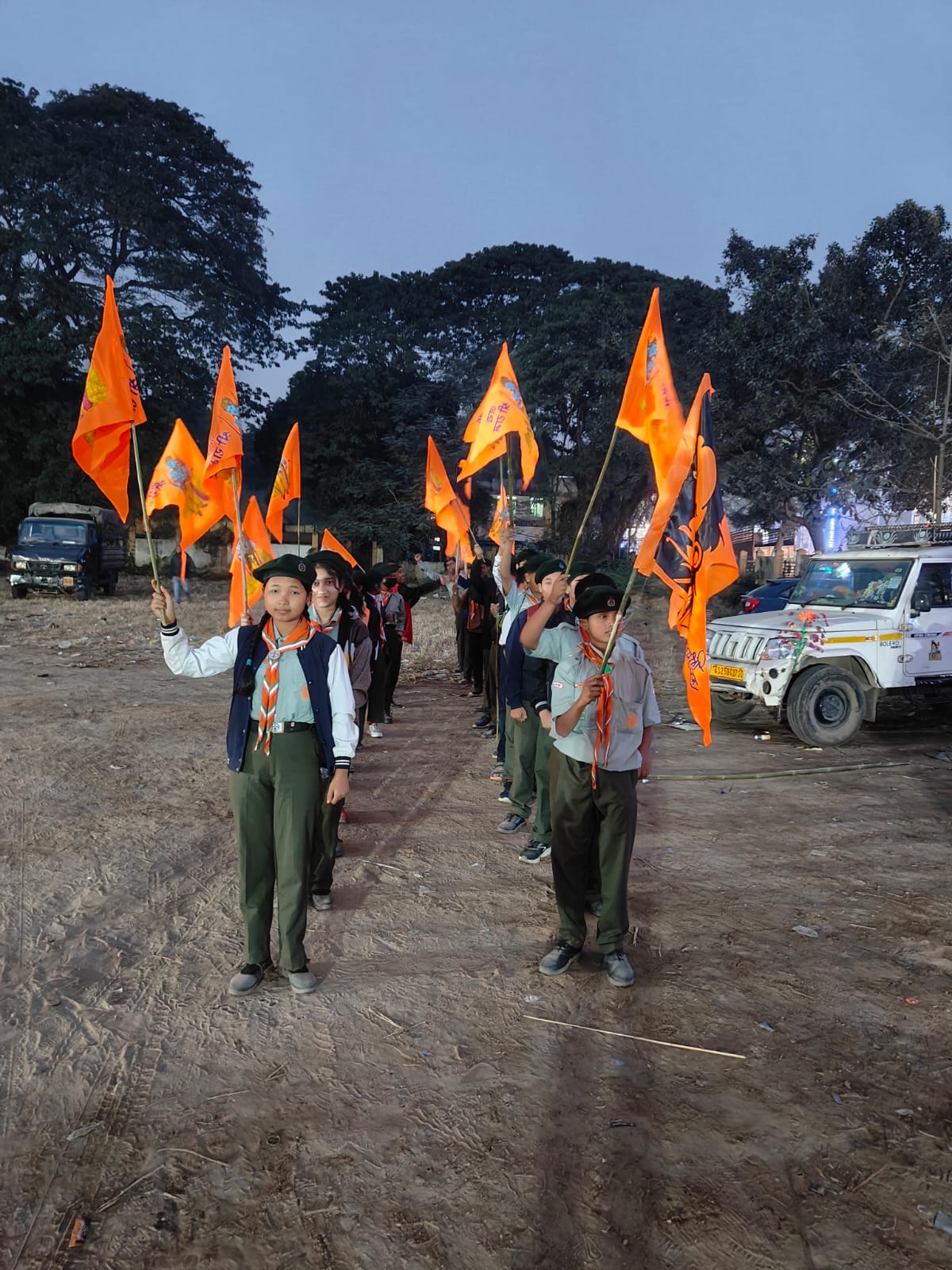
At international level Scouting perceives one of its roles as the promotion of international harmony and peace. Various initiatives are in train towards achieving this aim including the development of activities that benefit the wider community, challenge prejudice, encourage tolerance of diversity. Programs take in help with non- scouting organizations including various NGOs, UN, religious institutions as set out in The Marrakech Charter. The Scout uniform is a widely recognized characteristic of Scouting. In the words of Baden-Powell at the 1937 World Jamboree, it "hides all differences of social standing in a country and makes for equality; but, more important still, it covers differences of country and race and creed, and makes all feel that they are members with one another of the one great brotherhood". The original uniform, still widely recognized, consisted of a khaki button-up shirt, shorts, and a broad-brimmed campaign hat. Baden-Powell also wore shorts, because he believed that being dressed like a Scout helped to reduce the age-imposed distance between adult and youth. Uniform shirts are now frequently blue, orange, red or green & shorts are frequently replaced by long trousers all year or only in winter. While designed for smartness and equality, the Scout uniform is also practical. Shirts traditionally have thick seams to make them ideal for use in makeshift stretchers—Scouts were trained to use them in this way with their staves, a traditional but deprecated item. The leather straps and toggles of the campaign hats or Leaders' Wood Badges could be used as emergency tourniquets, or anywhere that string was needed in a hurry. Neckerchiefs were chosen as they could easily be used as a sling or triangular bandage by a Scout in need. Scouts were encouraged to use their garters for shock cord where necessary.
The swastika was used as an early symbol by the British Boy Scouts and others. Its earliest use in Scouting was on the Thanks Badge introduced in 1911. Lord Baden-Powell's 1922 design for the Medal of Merit added a swastika to the Scout fleur-de-lis to symbolize good luck for the recipient. Like Rudyard Kipling, he would have come across this symbol in India. In 1934, Scouters requested a change to the design because of the later use of the swastika by the German National Socialist Workers (Nazi) Party. A new British Medal of Merit was issued in 1935. Scouting and Guiding movements are generally divided into sections by age or school grade, allowing activities to be tailored to the maturity of the group's members. These age divisions have varied over time as they adapt to the local culture and environment. Scouting was originally developed for adolescents— youths between the ages of 11 and 17. In most member organizations, this age group composes the Scout or Guide section. Programs were developed to meet the needs of young children (generally ages 6 to 10) and young adults (originally 18 and older, and later up to 25). Scouts and Guides were later split into "junior" and "senior" sections in many member organizations, and some organizations dropped the young adults' section. The exact age ranges for programs vary by country and association.
Influences Movement characteristics
Scouting is taught using the Scout method, which incorporates an informal educational system that emphasizes practical activities in the outdoors. Programs exist for Scouts ranging in age from 6 to 17 (though age limits vary slightly with country) and program specifics target Scouts in a manner appropriate to their age.
Scout method
The Scout method is the principal method by which the Scouting organizations, boy and girl, operate their units. Scouting organizations are defined as a voluntary non-political educational movement for young people open to all without distinction of origin, race or creed, in accordance with the purpose, principles and method conceived by the Founder of the movement Lord Baden Powell. It is the goal of Scouting "to contribute to the development of young people in achieving their full physical, intellectual, social and spiritual potentials as individuals, as responsible citizens and as members of their local, national and international communities." The principles of Scouting describe a code of behavior for all members, and characterize the movement. The Scout method is a progressive system designed to achieve these goals, comprising seven elements: law and promise, learning by doing, team system, symbolic framework, personal progression, nature, adult support. The Scout Law and Promise embody the joint values of the Scouting movement worldwide, and bind all Scouting associations together. The emphasis on "learning by doing" provides experiences and hands-on orientation as a5 practical method of learning and building self-confidence. Small groups build unity, camaraderie, and a close- knit fraternal atmosphere. These experiences, along with an emphasis on trustworthiness and personal honour, help to develop responsibility, character, self-reliance, self-confidence, reliability, and readiness; which eventually lead to collaboration and leadership. A program with a variety of progressive and attractive activities expands a Scout's horizon and bonds the Scout even more to the group. Activities and games provide an enjoyable way to develop skills such as dexterity. In an outdoor setting, they also provide contact with the natural environment.
Since the birth of Scouting in 1907, Scouts worldwide have taken a Scout Promise to live up to ideals of the movement, subscribe to the Scout Law. The form of the promise, laws has varied slightly by country over time. The Scout Motto, 'Be Prepared', has been used in various languages by millions of Scouts since 1907. Less well- known is the Scout Slogan, 'Do a good turn daily'.
Restitution OF HINDUSTAN SCOUTS AND GUIDES:
Due to monopoly of only one organization in the field of Scouting there was insufficient progress rather “Bharat Scouts & Guides” was failed to cover even 1% of youth of India after having every kind of financial and official support of Central & State Governments. Not only this organization of Bharat Scouts & Guides, either Central or State Branches indulged in high level corruption. In 1997-98 they were caught for selling their certificates to non scouters and guiders, even BSG alleged of selling false Rashtrpati Scouts Guides certificates so to facilitate scout & Guide cadets to avail concession in higher education and jobs. The college and university students of all over India agitated on roads and gave Memorandum to the then Mahamahim Rastapati Sh. K.R. Narayanan Ji and some M.P.’s also raised questions in Parliament against the corruption.
Zee News channel broadcasted the whole corruption Inside story. It was found correct. So the than Mahamahim Rastapati Sh. K.R. Narayanan Ji withdrew the Chief Patronship of Bharat Scouts & Guides and stopped to sign over the Certificates of Rastrapati Scouts, Guides, Rovers and Rangers Awards and ordered not allow any kind of function related to Bharat Scouts & Guides in Rastrapati Bhawan. (It continued till 2008).
He also suggested concerned Ministry of Youth Affairs & Sports, Govt. of India to open the doors in the field of Scouting in India for other N.G.O.s. The then Deputy Secretary Smt. Minakshi Sharma (Youth Affairs) to Govt. of India directed to include another scouting Association.
The decision to form said parallel National Association under the Presidentship of Shri Saheb Singh Verma at the time of Celebration of much delayed (scheduled in 1977-1978 withheld due to imposed emergency) all India level Hindustan Scout and Guide Swarn Jayanti Jamboree finally held at DDA Park of Sec.-10, Rohini, New Delhi, from 26-04-1998 to 30-04-1998, with the financial assistance of Delhi Government.
Now this National alliance brought back the glorious ancient era of Hindustan Scouts and Guides Association originally founded by Pt. Madan Mohan Malviya and Late Sri Ram Bajpai in 1928 and with the courtesy Late Dr. Sahib Singh Verma as first as well Founder National President of Hindustan Scouts and Guides. It was again registered under S.R. Act XXI of 1860 on 26-11-1998. with registration no. S-33939/1998 and its office registered office at B-4/52A, Keshav Puram, New Delhi -35 but still operated from west Block, Indira Gandhi Stadium, ITO, New Delhi- 2. Which was made available to HSGA on special request to then PM Shri A B Vajpei by effort of then Sports Minister Smt Uma Bharti and successor Sports Minister Shri Vikram Verma. And the contribution of then President HSGA Shri Saheb Singh Verma was unforgettable.
However, due to commonwealth games 2010 the office was asked to vacate by the government and so with No option all office documents and property has moved to the Residential one room DDA flat of then National Secretory Sriniwas Sharma.
In 2003 Shri Narsing Mengji (MLA) Vice President sworn in as President and in 2013 on the request of Shri Mengji Shri Purshottam Rupalla elected/nominated in house as President. Under the leadership of Shri Purshottam Rupalla and the new team HSGA soars high and spread all across India. HSGA received Grant in Aid of Rs75 lakh pa from GOI and based on this many other state government has issued regular Grant in Aid to units of HSGA.
Court stay on de-recognition and re-recognition
BS&G could not bear it and to withdraw the recognition of HS&G, ran to Delhi High Court in fort ex- party stay (case no –WP (C) 2041/2001) against the recognition up to next hearing but it wasted 8 months and the stay vacated on 20-11-2001. but the Ministry did not do it and filed a false recovery case no. 1640/2006 against HS&G so that the Grants and other facilities may still withdrawn. Which was amicably settled and closed on 22- 5-2014. Now HS&G spread all over India within 3 years in a survey in 2004 its membership reached 30lac. Ministry asked them to withdraw the court case no. 2041/2001 otherwise recognition of both may be withdraw so BS&G withdrew the court case no. 2041/2001 on 8-11-2004. HS&G also got court stay in Delhi High Court on 22 July 2005, WP (C) no. 11820/2005 against YOI and report High court ordered the ministry to release the Grant-in-Aid and other facilities to HS&G.
New Govt. Policy
The revised scheme of Promotion of Scouting and Guiding in India Was declared on 14-02-2001 vide order No. F. 2-1/2000-YS-IV by Ministry of Youth Affairs & Sports Govt. of India. Under which any registered N.G.O. may use Scouts and Guides as general term and any it may be recognized as National Association if it has more than 10 State Branches. And there was the condition to be affiliated/recognized by any National or international org. Under this policy Hindustan Scouts and Guides was 3 rd time recognized by Govt. of India vide order No. F.20- 2/99-YS-IV dated 07-03-2001. Soon it spread all over India.
In order to reform the NGO’s working and transparence MoYA brought an order vide F-46-6/2016-NPYAD dated 19.09.2017 and asked the 70 years old office bearers and More than 9 years continued in-position office bearers to step down immediately.
Current Position
So on 2 nd Oct 2017 with the National Council meeting all office bearer above 70years have step down. Another Allegation fall on SNS that due to greedy Nature and with luring act on one lady office worker, he is NOT willing to leave the HSGA control, so Bank accounts of HSGA was debit blocked by President Rupala ji letter to FM and Grant in Aid was withheld by the GoI on complaints of several office bearer. Despite this, HSGA ex-National Secretary and also the owner to residential flat Sriniwas Sharma started same operation and in this protest elected National Secretory Mr. Akash Sharma resigned. Then charge of National Secretory again given to joint Secretary Dr.Atul Kumar and on his call National Executive and National Council meet and nominated Smt.Mukesh Sharma, National Secretory but she too crossed 70 years age on 31 st March 2018 and so Charge of National Secretory given to Dr.Atul Kumar. In his absent of Vinod Bidhuri NC call off National Council meeting without proper procedure of 60 days’ notice etc and served information to all members on 13 th May 2018.
In this National Council meeting Vinod declared himself as National Commissioner and National Secretary both and Sriniwas Sharma joined again in the team. But, Honorable High Court in his order dated 5 th Sept. 2018 declared appointment/nomination/election of Vinod declared invalid and so new election process started under the charge of Joint Secretory Dr.Atul Kumar from December 2018. Vinod summoned with show cause notice which he did not replied and so acting President Shri Har Swaroop Sharma removed Vinod from National Secretary Post. With the conciseness of all members and with the consultation of Chairman and General Secretary another National Executive meeting called on 2 nd March 2019 but NCC Mr.D.R.Yadav and Treasurer Mr. Maha Singh did not participated.
However, In this meeting house restricted Vinod from all post and primary membership of HSGA and appointed Champat Singh as National Secretary. National Election was declared to be held on 5 th May2019 at Raipur but on 3 rd May 2019 in case No. 364/2019 filed by Vinod on 6 th March 2019 after expulsion issued interim order. In Para 7 &8 and Para 14 and 15 of judgment, Trail Court stayed election to be held on 05.05.2019 and gave verdict against Sriniwas Sharma. Henceforth SNS cannot participate in election, meetings, representation or signing letter head. The order also stops Vinod to act as National Secretary. However Court has permitted Dr. Atul Kumar National Joint Secretary and Rakesh Mishra, Head Quarter Commissioner. An appeal in this regard has filed case No MCA 22/ 2019 and the judgment arrived on 25.05.2022 and in this againg Vinod is clearly removed termed as so-Called National Secretary. Vinod moved to Delhi High Court and case 746/2022 heard in the bench of Honorable Delhi High Court Judge Mrs M.P.S. Arora, on 4 th Jan 2024 pronounced verdict. In this Vinod is clearly denied as positioned at National Secretary as well election of 05.05.2019 stands illegal .
In the mean time On 6 th Feb 2022 Mr Champat Singh attained the age of 70 years. So the charge came to Dr.Atul Kumar, NJS again and in the National Executive is called on 27 th Feb 2022. House elected Shri Girish Juyal as National Secretary and on 24 th April 2022 it is confirmed by the House again. Therefore Chairman Shri Narsingh Mengji issued Appointment to Shri Girish Juyal as National secretary.
Then in the Banaras Election dated 2 nd Oct 2023 National Council completed the election and Mr Narsing Mengj was elected as President by ballot voting.
New Education Policy
Central Government has come out with the New Education policy 2020 under the leadershipof PM Narendra Modi Aiming to imparting skilful education in childhood. This Policy has provided a wider Arena to Scouting education in Schools.
National - President
Girish Juyal
Vice President
Mrs Vanita Sharma
Awdhesh Kumar Sharma
Dr. Om Prakash Sinha
Dilip Arora
Deepak Kalita
National Joint Secretary
Dr. Atul Kumar 9313450055
National Chief Commissioner
Mr. Madhusudan Gupta
National Organising Commissioner
Mr SNS Suman LT
National Training Commissioner
Mr. Y.K.Saksena
Copyright | Hindustan Scout & Guides. All Rights Reserved
